Oya Temple and Heiwa Kannon with Kids: Ten stone Buddhas, one giant.
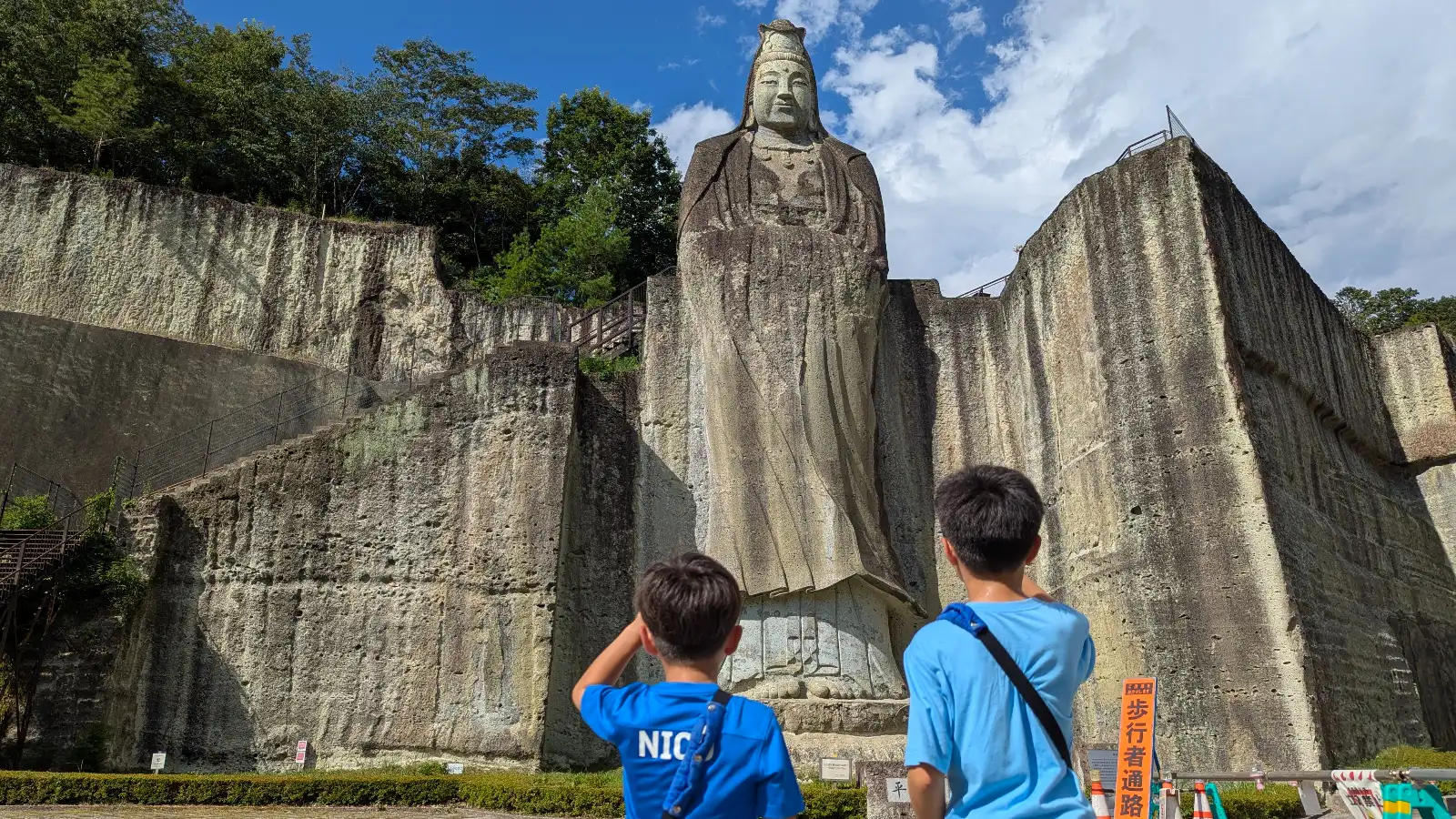
Stone Buddhas you may look at but never photograph are a quiet study for a child who takes everything in and a long pause for a child who needs to move.
Groups pay less and book ahead; the Heiwa Kannon is free to visit.
Opens at 9:00 from October to March; closed Thursdays (open on holidays) and December 26 to 31.
The halls first, then the walk to the 27 m Heiwa Kannon.
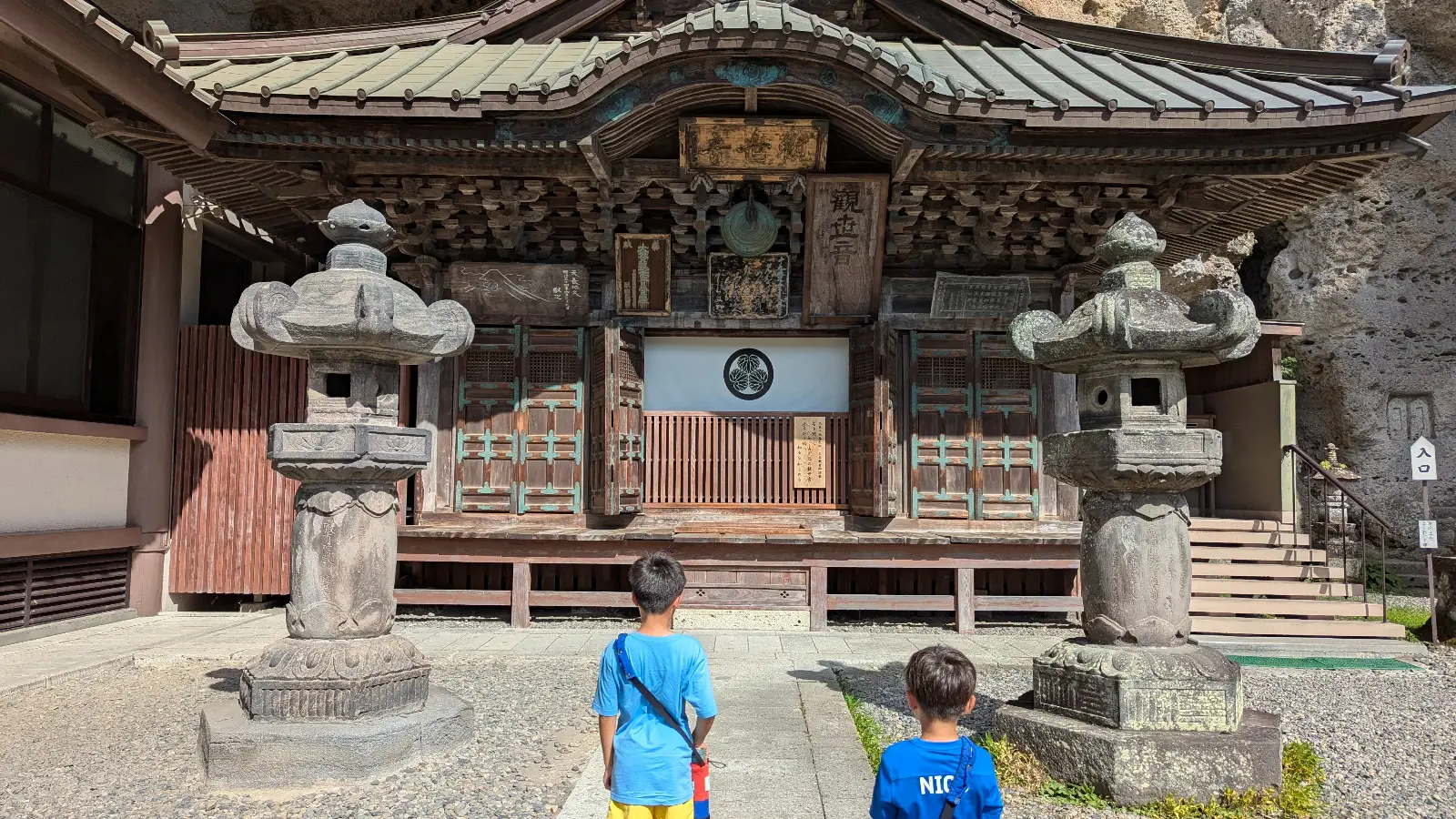
Carvings reward a child who can study detail; no photographs of the stone Buddhas.
The Heiwa Kannon’s face is reached by stairs.
Some links on this page are affiliate links. LuNi may earn a commission at no extra cost to you.
Is Oya Temple and Heiwa Kannon worth it with kids?
The short version, before the costs, the timings and the case for each child.
Yes, as long as the day is not a Thursday. Oya Temple, in the Oya district of Utsunomiya, keeps ten stone Buddhas in its halls, and nearby stands the Heiwa Kannon, a statue twenty-seven meters tall carved by local stonemasons, free to visit on city parkland. A child who takes everything in meets carvings to study at their own pace, in halls where cameras stay down. A child who likes to know the plan can have the whole precinct named before the gate. The child it asks most of is the one who needs to move, because the halls are made for looking and the outlet is outdoors, around the statue and the pond. Two decisions shape the day: which day of the week, and whether to add the quarry on the same road.
Planning Your Visit to Oya Temple and Heiwa Kannon with Kids.
Three decisions are worth making before the day, and the first is the calendar. The temple keeps a weekly closing day and a short year-end break, so a family planning a weekday in Oya checks the date twice. The second is the camera. The stone Buddhas inside the halls may not be photographed, and a child who has filmed everything else on the trip needs to hear that before the gate, not in front of a carving. The third is how much of Oya to take on. The quarry museum sits on the same road and closes on a different weekday, which makes the pairing easy to plan and easy to overdo, and many families fold Oya into a trip built around Nikko’s family stops.
Every LuNi attraction guide starts with a visit, with our own children
LuNi rates and writes about attractions only after visiting them with children. Luca and Nico were at Oya Temple and Heiwa Kannon, and what they did there is recorded further down this page, including how each child actually met it.
Children arrive with different tolerances: for noise, for lines, for standing still, for being on their feet all day. A guide written for the average of them helps almost nobody. So every place on this site is read four ways, and each verdict says which children it already suits and what makes it work for the rest. Whoever you are bringing, the answer here is built for your family rather than for a general reader.
Restricted-movement depletion builds in halls made for looking, so spend the energy first outdoors around the Kannon and the pond, and keep the halls brief.
Sensory-input depletion stays low among carvings studied at the child’s pace, with sutras chanted outside the halls, so let the child set the time.
Unfamiliarity and unconfirmed structure ease in a precinct whose every stop can be named ahead, so read the map aloud and explain the photo rule.
Sustained walking and standing add up over an Oya day that pairs the temple with the quarry’s stairs, so do one of the two properly.
Hotels we would book for this visit.
There is no hotel beside the temple we would book for a family, so these three are bases for combining Oya with Nikko: one in Nikko town, where the drive north ends, and two in Kinugawa Onsen, where two other family days begin.
| Property | The LuNi Reason |
|---|---|
| LUNI Pick Nikko Kanaya Hotel Near the Shinkyo bus stop, in Nikko town | The drive north from Oya reaches Nikko Toshogu in about forty minutes, and this hotel is at the shrine end of town. A temple morning, the drive, then a first evening in Nikko puts the family where the next day’s shrine or waterfall begins, with no early start from Utsunomiya to plan around. |
| Asaya Hotel In Kinugawa Onsen | For a family giving the next day to Kinugawa. The buses to Edo Wonderland and Tobu World Square both leave from Kinugawa Onsen Station, so a quiet day of carvings can be followed by a day of doing or a day among the models without packing everything up again. |
| Hoshino Resorts KAI Kinugawa About 15 minutes on foot from Kinugawa Onsen Station | A Kinugawa base within walking distance of the station, for a family arriving by train and staying put for a few nights. After a day of studying carvings, the evening a thoughtful child has earned is a short walk from the platform rather than another transfer. |
Nearby attractions, matched to your child.
Three pairings for what a morning of looking leaves over: a child who has been still too long, a child who wants the calm to continue, and legs that need the next big sight to be easy.
| Pairing | Why This Solves the After-Visit | For Your |
|---|---|---|
| LUNI Pick Oya History Museum On the same road, north of the temple | After halls made for looking, the Oya History Museum gives a moving child a vast stone floor to cross. Restricted-movement depletion discharges there, but the quarry is hard on a Sensor, whose sensory input builds in the cold below ground, so plan it for one child, not both. | Dynamo |
| Wakayama Farm About 10 minutes by car from the Oya museum | The temple is gentle on a child who takes everything in, and Wakayama Farm keeps it that way outdoors: a bamboo forest with crafts on weekends. Sensory input stays low in the open air, provided the child is warned about the mist machine in one clearing. | Sensor |
| Kegon Waterfall Above Nikko, at Chuzenji Onsen | An Oya day spends a Sprinter’s legs on halls, the Kannon grounds and, if the quarry is added, its stairs. At Kegon Waterfall the elevator carries the family down to the falls and back, a kind reward for a walking and standing reserve already drawn down. | Sprinter |
Oya History Museum
On the same road, north of the temple For YourDynamo
Wakayama Farm
About 10 minutes by car from the Oya museum For YourSensor
Kegon Waterfall
Above Nikko, at Chuzenji Onsen For YourSprinter
How two children actually met this attraction.
Two children stood in front of the same carved stone and the same giant statue, and one of them spent the visit looking up while the other spent it moving. For one, the first question was whether the rock above him would hold, and he could not give his attention to anything else until he had looked at it for a long time. For the other, the stone was something to put his hands on, and the stairs were the main event. Neither cared who had carved the Buddhas, or when. The temple asked both boys to be still in its halls, and each found his own way around that request, one with a question he carried through the visit, the other with his feet.
Luca’s first reaction inside the cave hall was to worry that the cliff overhead might break and bring the temple down, and he kept glancing up at the rock face before he would settle into looking at anything else. The climb to the observation point was hard for him, and he took it slowly. Once he was up and looked down, he decided out loud that the people below looked like grains of sand.
This is the Anchor pattern. A child whose Reserve depletes through unfamiliarity and unconfirmed structure meets a place like this as a question before it is a sight, and Luca’s question was whether the rock would hold. Families with a similar child should take the question seriously without inventing an answer to it: acknowledge it, stay near the entrance while the child looks, and offer a fixed spot from which to watch everything else. The day can go on around a question that has not been answered.
Nico went straight for the stairs beside the Kannon and wanted to climb them, treating the climb itself as the main event rather than the statue. He ran his hands along the rock walls and liked their enclosed, tunnel feel, narrating as he went. The interior rooms held him only briefly; within a few minutes of standing still he was restless and scouting for the next thing to do or touch.
This is the Dynamo pattern. A child whose Reserve depletes through restricted movement finds whatever a place offers the body, and Nico found stairs to climb and walls to touch. Families with a similar child should put the moving part of the visit first, outdoors around the Kannon and the pond, where the white snake’s head at the Benten-do is there to be patted, and keep the halls short and near the end, so stillness comes after the movement rather than before it.
Stone Buddhas carved long ago, and a giant statue watching over the valley, invite a child to be still and simply look. In halls where the carvings may not be photographed, a child learns to remember with their eyes rather than a camera, and that small restraint changes how closely they see. Places of quiet devotion show children that some spaces ask for respect rather than activity. A morning spent looking carefully teaches a child that stillness can be a way of taking something in.
The LUNI Rating for Oya Temple and Heiwa Kannon.
One fact sits under all four verdicts: Oya Temple is a place for looking, stone Buddhas in halls where cameras stay down, with a giant statue and a pond outside. That suits a child who takes everything in, who can study the carvings at their own speed, and a child who needs to know what comes next, because the whole precinct can be named in advance. It asks more of a child who needs to move, because the halls give that child little to do, and of tired legs, because an Oya day rarely stops at the temple gate, and the next stop usually has stairs.
Move first, look second. The Dynamo depletes through restricted movement, and the heart of Oya Temple asks for the opposite of movement. The halls hold ten stone Buddhas to be looked at, not photographed, and a child whose Reserve drains when the body is held still is asked to stand and study. For this child the halls are the cost of the visit, and the only question is how to pay it. Outdoors is better. The Heiwa Kannon stands on city parkland nearby, free to visit, and at the Benten-do in the middle of the pond visitors are invited to pat the head of a white snake, the kind of small physical task a moving child remembers.
Start outside, and the order does the rest. Start outdoors, at the Kannon and the pond, and let the child spend the energy they arrived with before going in. Keep the halls short, give the child one thing to find in them, and leave while looking is still their choice. Older children may want the Mt. Otome trail, which the temple permits, but it has no safety fences, is slippery in places and ends at a dead-end summit, so it is for sure-footed teenagers in good weather and sports shoes.
What this means for your Dynamo: restricted movement is concentrated in the halls. A younger Dynamo needs the Kannon and the snake’s head first, and a short look inside; an older one can take the trail in good weather.Let the child set the time inside. The Sensor depletes through sensory input, and Oya Temple’s input is the slow kind: carved stone, taken in at whatever pace the child chooses. The temple asks that sutras be chanted outside the halls rather than in them, and the camera rule keeps phones down, so the halls stay places for looking. For this child, a precinct built around ten stone figures and a pond is a gentle place to spend the morning.
Keep it that way. Hold the visit to the halls, the pond and the statue, and let the child decide how long to stay with each carving. The one thing to prepare is the Heiwa Kannon: a statue twenty-seven meters tall is a big thing to meet, and some children want to see it from a distance before walking up to it. Leave the quarry museum up the road for another day, because it asks far more of this child than the temple does.
What this means for your Sensor: sensory input stays low among carved stone. A younger Sensor needs the Kannon seen from a distance first; an older one can study the halls at length and leave the quarry out.Walk the map before the gate. The Anchor depletes through unfamiliarity and unconfirmed structure, and Oya Temple can be laid out in full before anyone arrives. The precinct map shows every stop: the reception, the Niomon gate, the halls, the Benten-do on its pond, the treasure hall and the Heiwa Kannon, with the Oya History Museum farther up the same road. A child who has heard that list knows the whole visit before it starts, and can check the stops off as they come.
Two things are worth saying out loud as well. The first is the day, because the temple is closed on Thursdays, and a child promised it on a Thursday meets a shut gate. The second is the camera rule inside the halls, told before it is discovered. If the child asks whether the rock above them is safe, do not invent an answer to comfort them; say what you can see, and let a fixed place to stand and look do the steadying.
What this means for your Anchor: unfamiliarity is answered by a precinct that can be named in full. A younger Anchor needs the map and the camera rule before the gate; an older one can guide the family around it.Choose the stairs you spend. The Sprinter depletes through sustained travel-style walking and standing, and on its own the temple asks for standing in the halls and a walk between the halls, the pond and the Kannon. The cost comes from what surrounds it. By bus the Oya area is about thirty minutes from JR Utsunomiya Station before anyone has taken a step, the Mt. Otome trail tempts older children into a real climb, and the quarry on the same road adds its own stairs down and back up.
Pick one, not both. Arrive by car if you can, since parking is free, and keep the temple as the day’s gentle stop. Add the quarry or the trail, not both, and put the Kannon grounds last, where a tired child can stop and look up without anyone asking them to climb anything. A Sprinter who ends the day standing still in front of a giant statue ends it well.
What this means for your Sprinter: walking and standing are modest at the temple and larger across an Oya day. A younger Sprinter needs the car and one stop added at most; an older one can choose between the quarry and the trail.The questions parents actually ask.
Oya Temple’s ten stone Buddhas sit inside its halls, so three things shape a visit: which days it is open, what children can and cannot do inside, and what else is nearby. Each answer is brief, and none of them takes more than a minute to act on. Avoid Thursdays and the last days of December, keep cameras down in the halls, and treat the quarry museum up the road as a separate decision, because it asks far more of some children than the temple does. For the day after two stone sites in a row, Lake Chuzenji is open shore at the top of the Nikko bus line.
Is Oya Temple and Heiwa Kannon worth visiting with kids?
Yes, on any day but Thursday. The temple’s halls hold ten stone Buddhas, and nearby stands the Heiwa Kannon, a statue 27 meters tall that is free to visit. It suits a child who likes to study things and a child who likes to know the plan. A child who needs to move should start outdoors, at the statue and the pond.
How much does Oya Temple cost?
Adults pay 500 yen, junior high students 200 yen and elementary children 100 yen, so two adults and two elementary children pay 1,200 yen. Groups pay 400, 150 and 70 yen. The Heiwa Kannon is city parkland, managed by Utsunomiya City, and it is free to visit. There is a free parking lot as well as the temple’s own.
When is Oya Temple open?
From April to September, 8:30 to 16:30, and from October to March, 9:00 to 16:30, with reception closing 20 minutes before. The temple is closed every Thursday, unless the Thursday is a public holiday, and from December 26 to 31. The Oya History Museum on the same road closes on winter Tuesdays instead.
Can you take photos inside Oya Temple?
No. Photographs are allowed in the grounds but not inside any building, including every stone Buddha. Tell children before they go in, and put phones and tablets away. The temple also asks that sutras be chanted outside the halls, and that anyone with a cold or a fever stays away from the visit.
How tall is the Heiwa Kannon?
27 meters. Oya stonemasons led by Hida Asajiro began carving it in 1948 and worked for six years, completing it in 1954, and it was consecrated in 1956, in memory of the war dead and for world peace. Utsunomiya City manages it today as parkland, and there is no charge to see it, before or after the halls.
Can children climb Mt. Otome at Oya Temple?
Climbing is permitted, but the trail has no safety fences, is slippery in places and ends at a dead-end summit, and it closes in bad weather. Wear sports shoes, go only in good weather, and treat it as a climb for older, sure-footed children with an adult close by, not as part of every visit.
Can you visit Oya Temple and Nikko Toshogu Shrine in one day?
By car, yes: the drive from the Oya area to Nikko Toshogu Shrine takes about forty minutes. Do the temple first and keep the Oya part to the halls and the Kannon, because the shrine’s stairways spend a Sprinter’s walking and standing reserve, and the day should save legs for them. Not on a Thursday.
How does Oya Temple compare with the Oya History Museum for kids?
They share a road and suit opposite children. The temple is a place for looking, with carved stone, a pond and a statue outdoors, and it is gentle on a child who takes everything in. The museum is a vast, cold quarry underground, reached by stairs, which a moving child loves and a sensitive child finds hard.
Where Oya Temple and Heiwa Kannon fits your Japan trip.
Official site and opening information: Oya Temple