National Museum of Nature and Science with Kids: The Pacing Problem.
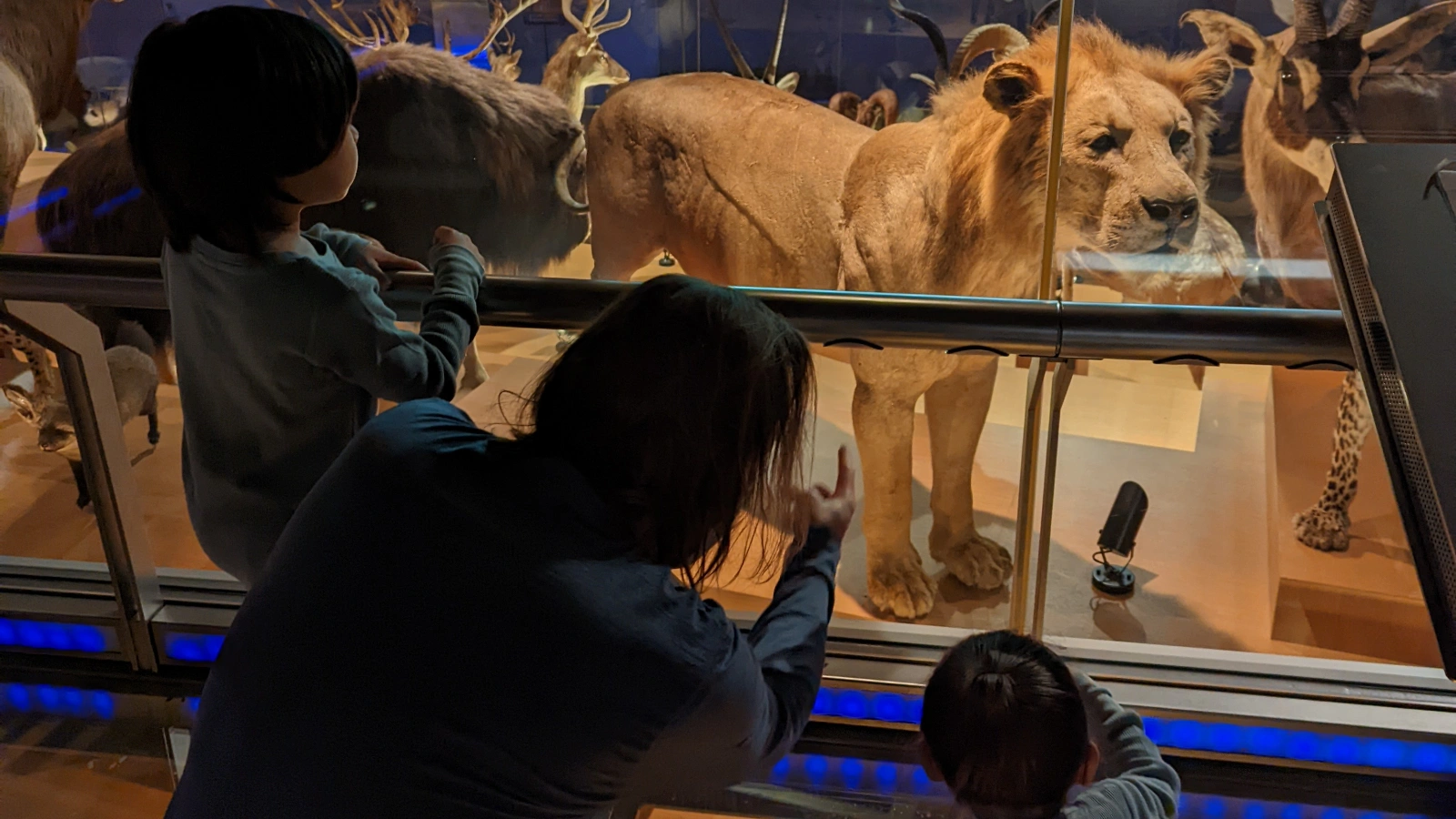
The National Museum of Nature and Science is free for children through high school, and its real challenge is pace: a day of galleries asks a lot of small legs.
Free through high school, and for anyone under 18 or 65 and over, with proof of age. E-tickets can be bought ahead; not required.
Closed Mondays (Tuesday when the Sunday or Monday is a holiday) and December 28 to January 1; open every day in August.
Same-day re-entry allows a break in Ueno Park between the two galleries.
ComPaSS, booked ahead, takes children up to sixth grade, mainly 4 to 6, only with a guardian.
Two strollers and two wheelchairs at the entrance desk, no booking; bring your own to be sure.
Some links on this page are affiliate links. LuNi may earn a commission at no extra cost to you.
Is the National Museum of Nature and Science worth it with kids?
The short version, before the costs, the timings and the case for each child.
Yes, and the price is the easy part, since children through high school enter free. What it asks of a family is pace. This is a museum of galleries and glass cases, and a child who reads will thrive while a child who needs to move will fade by the afternoon. So plan it in halves. Take the galleries that matter most in the first hours, rest in the Japan Gallery lounge, which is set aside for eating and resting, and use same-day re-entry for a walk in Ueno Park before the second half. For children of about 4 to 6, book ComPaSS, a timed exploration room, ahead. A day planned this way works for almost any child.
Planning Your Visit to the National Museum of Nature and Science with Kids.
Three decisions shape the visit. The first is the day: check the closing day against your dates, remembering that it moves after a holiday and that August has none. The second is ComPaSS for a younger child, which everyone in the family books by date and time, adults included, so reserve it before the trip, since each session has a cap. The third is the midday break, which matters more here than at most museums in Tokyo. Same-day re-entry is arranged at the information desk, so the family can step out into Ueno Park, walk, eat in the open, and come back for the second half with the child ready for it. That break is where the rest of Ueno comes in, from the park’s paths to the zoo.
Every LuNi attraction guide starts with a visit, with our own children
LuNi rates and writes about attractions only after visiting them with children. Luca and Nico were at the National Museum of Nature and Science, and what they did there is recorded further down this page, including how each child actually met it.
Children arrive with different tolerances: for noise, for lines, for standing still, for being on their feet all day. A guide written for the average of them helps almost nobody. So every place on this site is read four ways, and each verdict says which children it already suits and what makes it work for the rest. Whoever you are bringing, the answer here is built for your family rather than for a general reader.
Restricted-movement depletion builds across galleries of glass cases, so book ComPaSS for a younger child and use re-entry for a walk in the park.
Sensory-input depletion stays manageable with a lounge for resting, no flash photography and same-day re-entry, so plan a quiet break at midday.
Unfamiliarity eases with a free guide on your phone, booked ComPaSS sessions and fixed hours, so load the guide and choose galleries at home.
Walking and standing build across two large galleries, with two strollers to lend, so bring your own and plan the lounge as a rest.
- Cost
- ¥630 adult / children freeFree through high school, and for anyone under 18 or 65 and over, with proof of age. E-tickets can be bought ahead; not required.
- Booking
- Adults only, online or at the counterA child needs no ticket at all, so the booking covers the adults alone.
Hotels we would book for this visit.
Pace is what a room can help with here. A museum of glass cases is easiest in halves, and a room in the same ward lets the break happen away from the gallery floor. Three of Ueno’s family hotels, the pick first.
| Property | The LuNi Reason |
|---|---|
| LUNI Pick NOHGA HOTEL UENO TOKYO | NOHGA is for a family giving Ueno a museum day and a zoo day. A museum of glass cases wears a moving child down by the afternoon, and a base in the same ward turns the midday break into a real one: back to the room to rest, then the park and the second half with energy restored. |
| &Here TOKYO UENO | The second base is for a family that wants to split the museum across two mornings. The museum’s argument is pace, and a base in the same ward makes two short visits as easy as one long one: the Japan Gallery one day, the Global Gallery the next, and neither asks a child to hold both. |
| Mitsui Garden Hotel Ueno | Mitsui Garden Hotel Ueno is a fixed base for the child who settles best when the week’s bed does not change. It serves the same museum day: galleries in the morning, a rest in the middle, the park and the zoo after, and a short ride back to bed for the child whose legs did the most work. |
Nearby attractions, matched to your child.
Three pairings for what a gallery day leaves unmet: animals in the same park for a child who has stood still too long, a seated aquarium for tired legs, and an open-air temple in Asakusa.
| Pairing | Why This Solves the After-Visit | For Your |
|---|---|---|
| LUNI Pick Ueno Zoo Ueno Park; the same park | Also in Ueno Park, Ueno Zoo turns the afternoon from looking at cases into walking between live animals. For a Dynamo whose restricted movement built up across the galleries, a zoo afternoon in the same park is the natural release, with no train to catch in between. | Dynamo |
| Sumida Aquarium Tokyo Skytree Town; Solamachi 5F and 6F | For a Sprinter whose walking and standing added up in the museum, Sumida Aquarium is a gentle next day, where chairs face the big Ogasawara tank, the Penguin Cafe has sofas, and a visit takes about ninety easy minutes, with places to sit on the way. | Sprinter |
| Senso-ji Temple Asakusa Station, 5 min; free | For a Dynamo held back by glass cases, Senso-ji Temple in Asakusa is free, open to the sky and flat underfoot, with the walk from the great gate to the main hall to lead. Restricted movement finally has ground to cover, and the hall opens early enough to come first another day. | Dynamo |
Ueno Zoo
Ueno Park; the same park For YourDynamo
Sumida Aquarium
Tokyo Skytree Town; Solamachi 5F and 6F For YourSprinter
Senso-ji Temple
Asakusa Station, 5 min; free For YourDynamo
How two children actually met this attraction.
Two children entered the same museum and wanted opposite things from it. One wanted to understand, and he was happiest where a display explained itself, losing track of time at a single case for long stretches. The other wanted to do, and he was happiest wherever he could act, fading fast in the rooms where there was only looking. That is the whole pacing problem, in one family, on one day. The answer is not to choose between them but to shape the day. Give the doer the first hours and the most active rooms, while his energy is highest. Give the reader the quieter middle of the day, after lunch, when the doer is resting in the lounge or walking in the park outside.
Luca read. He stopped at the panels most children walk past, worked through the explanations of how the exhibits fit together, and had to be steered toward the next room more than once because he had lost track of time at a single case. The dinosaur hall held him, but so did the quieter earth-science displays, where the appeal was the mechanism rather than the spectacle.
This is the Anchor pattern. A child whose Reserve depletes through unfamiliarity and unconfirmed structure finds a museum that explains itself reassuring rather than tiring, because every panel confirms how the place fits together. For a similar child, expect a slow start and a long, absorbed middle, and protect his reading time rather than hurrying him. Load the free guide on your phone before you go, so he has more to follow once he settles, and let him lead the order of the rooms.
Nico moved. He was strongest in the first hour, talking continuously as he went, drawn straight to the animatronic dinosaurs and the hands-on zones where he could do something rather than look at something. In the glass-case galleries his attention thinned quickly and he started looking for the next room before the current one was finished, and by the later stretch his energy had visibly dropped with all the standing and viewing.
This is the Dynamo pattern. A child whose Reserve depletes through restricted movement finds his energy in the rooms where he can act, and loses it in the rooms where he can only look. For a similar child, put the active parts of the museum first, while morning energy is high, and treat the walk between the two galleries and a break in Ueno Park as the movement the glass cases cannot give him, and plan both before he needs them.
A great natural history museum lets a child stand in front of the deep past and feel small in a good way. Skeletons, meteorites and whole landscapes behind glass invite the questions children ask most naturally: how old, how big, how did it get here. The answers matter less than the habit of asking. That entry is free for children through high school says something too: this knowledge belongs to them. Children who learn early that museums are places to wonder, rather than endure, return to them all their lives.
The LUNI Rating for the National Museum of Nature and Science.
The verdicts split on pace. For a child who reads, a museum that explains itself is a pleasure, which is why the Anchor and the Sensor both do well: there is a free guide to follow and a lounge to rest in. For a child who needs to move, galleries of glass cases are hard going, which is why the Dynamo needs a plan, and the Sprinter does too, since the museum lends only two strollers across a long day on foot. Pace is the whole plan, for every child. Split the day at the lounge, and the mover gets two short halves, not one long one.
Give the active rooms the morning, and the park the middle. The Dynamo depletes through restricted movement, and this is a museum of looking: galleries and glass cases, with eating allowed only in set places. A child who needs to act will be happy early and tire by the afternoon. For a younger child, ComPaSS helps, an exploration room for children up to sixth grade, mainly 4 to 6, booked ahead in short sessions with everyone in the family on the booking.
Pacing is the fix. Put the rooms your child most wants to see first, while energy is high, and book ComPaSS for a younger child. Then use the re-entry rule: the family can step out into Ueno Park for a walk in the open and come back for the rest. A Dynamo who has moved at midday will manage the afternoon galleries far better.
What this means for your Dynamo: galleries of glass cases are where restricted movement builds. A younger Dynamo needs a booked ComPaSS session and a walk in the park; an older one needs the most active rooms first, in the morning.Plan the lounge as part of the visit. The Sensor depletes through sensory input, and a museum can wear on this child over a long day. Here the museum helps. The Japan Gallery basement lounge is set aside for eating and resting, with Kujira Cafe beside it. Photography is handheld only, with no flash, so no sudden bursts of light come from other visitors. And same-day re-entry means the family can leave for quiet in the park and return.
So plan a quiet break in the lounge at midday rather than waiting for the child to need one. Choose a few galleries, not all of them, and let the child set the pace within each. If the museum is busy, step out into Ueno Park for half an hour and come back. A Sensor who has rested in the middle of the day will enjoy the afternoon as much as the morning.
What this means for your Sensor: input stays manageable with a lounge for resting, no flash and re-entry to the park. A younger Sensor needs a planned midday rest; an older one can choose the galleries and the moments to pause.Load the free guide before you go. The Anchor depletes through unfamiliarity and unconfirmed structure, and this museum explains itself well. The free HANDY GUIDE runs on your own phone through the museum’s Wi-Fi, giving a reading child a thread to follow. ComPaSS sessions are booked at fixed times, five a day, and the museum’s day has a fixed shape too, with a set opening and a set last entry that a child can be told the night before.
So give this child the structure in advance. Load the guide, choose the galleries together, and book ComPaSS for a younger child at a set time. The Kahaku Navi tablet is an option for an older child, a paid rental in limited numbers, so treat it as a bonus rather than the plan. An Anchor who arrives knowing the plan will spend the day absorbed rather than anxious, and may well lead the family from room to room.
What this means for your Anchor: unfamiliarity eases with a free guide on the phone and booked ComPaSS times. A younger Anchor needs the galleries chosen at home; an older one can follow the guide and set the order.Bring a stroller, and rest in the lounge. The Sprinter depletes through sustained travel-style walking and standing, and a museum of this size asks for plenty of both across the Japan Gallery and the Global Gallery. The museum lends only two strollers and two wheelchairs, at the entrance desk, with no booking, so a family cannot count on one being free. Nursing rooms are in the Japan Gallery basement and on the Global Gallery third floor.
Bring your own stroller or a carrier for a small child, and plan the basement lounge as a real rest rather than a quick snack. Use same-day re-entry for a break outside if the day runs long, and choose fewer galleries rather than trying to see everything. A Sprinter who sits down twice will finish the day on foot, and a museum this rich is worth seeing slowly rather than all at once.
What this means for your Sprinter: walking and standing build across two large galleries, with few strollers to lend. A younger Sprinter needs a stroller from home and a long rest; an older one needs fewer galleries and a seated lunch.The questions parents actually ask.
Children through high school enter free. The museum closes on Mondays, and on the Tuesday when the Sunday or Monday is a holiday, but opens every day in August. ComPaSS, the timed room for children of about 4 to 6, is booked by everyone and paid for from age 2. The basement lounge is for eating and resting, and it is where a long day is split in two. And only two strollers are lent, so a family with a small child should bring one. This one rewards the family that takes it slowly, with Ueno Park outside for the break between halves.
Is the National Museum of Nature and Science worth visiting with kids?
Yes, and for a family it is one of the best-value days in Tokyo: children through high school enter free, and adults pay 630 yen for the permanent exhibitions. It is mostly a museum of galleries and glass cases, so pace the day, with a break in the lounge and a walk in Ueno Park between buildings.
How much does the National Museum of Nature and Science cost?
Adults and university students pay 630 yen for the permanent exhibitions. Elementary, junior high and high school students are free, as is anyone under 18 and anyone 65 or over, with proof of age. Special exhibitions are priced separately. Same-day re-entry is arranged at the information desk on the Japan Gallery basement floor.
When is the National Museum of Nature and Science closed?
It closes on Mondays, and on the Tuesday instead when the Sunday or Monday is a public holiday, and from December 28 to January 1. In August it opens every day. Special exhibitions can shift the closing days, so check the calendar. Hours are 9:00 to 17:00, with last entry 30 minutes before closing.
What is ComPaSS at the museum?
ComPaSS is a booked exploration room for children from birth to sixth grade, mainly ages 4 to 6, always with a guardian 18 or over. Everyone books a date and time; each person pays 300 yen, adults included, except children under 2, who are free but need a booking. Sessions last 45 minutes, for up to 60 people, five times a day from 10:00.
Where can you eat at the National Museum of Nature and Science?
The Japan Gallery basement lounge is set aside for eating and resting, and Kujira Cafe sits in the same lounge, with 38 seats. Restaurant Museion, with 140 seats, is on the Global Gallery mezzanine. Both open from 10:30 to 17:00. Eating is not allowed in the exhibit rooms, so plan the snack stop in the lounge.
Can you borrow a stroller at the National Museum of Nature and Science?
Yes, though there are only two, along with two wheelchairs, lent at the entrance desk with no booking. A family relying on one should bring its own or a carrier. Nursing rooms are in the Japan Gallery basement, near Theater 360, and on the third floor of the Global Gallery.
Is there a guide for children at the museum?
The free HANDY GUIDE runs on your own phone through the museum’s Wi-Fi, which is the easiest way to give a reading child more to follow. An audio guide costs 320 yen, and the Kahaku Navi tablet is a paid rental at 320 yen, cash only, with photo ID, in limited numbers.
How do you get to the National Museum of Nature and Science?
The museum is at 7-20 Ueno Park in Taito Ward, about five minutes on foot from the Park Exit of JR Ueno Station, and about ten minutes from Tokyo Metro Ueno and Keisei Ueno. The JR Park Exit is the shortest walk for a family with small children, and it brings you into the park itself.
Where the National Museum of Nature and Science fits your Japan trip.
Official site and opening information: National Museum of Nature and Science