teamLab Borderless with Kids: The Museum With No Map.
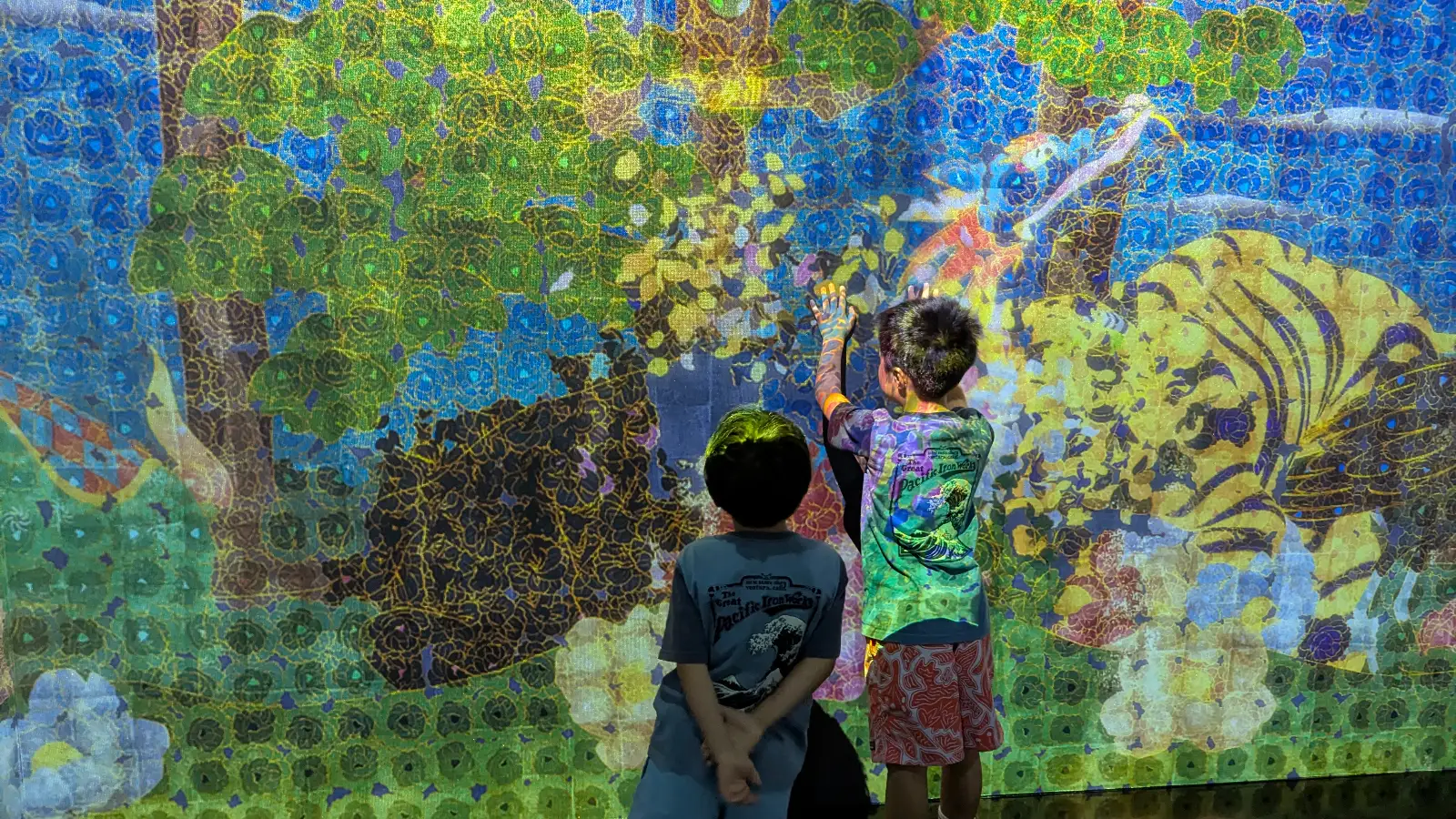
teamLab Borderless is a museum with no map and no time limit, which thrills a child who loves to explore and tests one who needs to know what comes next.
Junior and senior high ¥2,800; 3 and under free. Book the timed pass ahead: on site costs ¥200 more, only while passes remain.
Standard hours; later closing on many autumn days, and no weekly closing day.
No time limit once inside, but no re-entry, so agree on the leaving time first.
Elementary age and under need a guardian of 18 or over; no child harnesses.
Strollers go to the luggage storage area; bring a carrier for the dark rooms and uneven floors.
Some links on this page are affiliate links. LuNi may earn a commission at no extra cost to you.
Is teamLab Borderless worth it with kids?
The short version, before the costs, the timings and the case for each child.
Yes, for most children, and for an explorer it can be the highlight of a Tokyo trip. teamLab Borderless is a museum of light and projection with no map, by design, and no time limit once inside, so a child can wander from room to room and find things for themselves, which is the whole pleasure of it. It asks more of two kinds of child. A child who is sensitive to light and sound will meet flashing light, loud sound, scent and dark rooms, often all at once. A child who needs a plan will meet a place built not to have one. For both, the two rest areas inside are the answer. Book a timed pass, carry the smallest child, and decide before you go when you will leave, since there is no re-entry.
Planning Your Visit to teamLab Borderless with Kids.
Three decisions shape the visit, all of them made at home, and the first is the pass. The Entrance Pass is timed, and buying on site costs more and depends on passes remaining, so book ahead; the date can be changed up to three times, until two hours before, though a pass cannot be canceled. The second is the smallest child in the family. Strollers go to the baggage area and child harnesses are not allowed, so bring a carrier. The third is the leaving time. There is no time limit inside, but no re-entry either, so agree with the children when the visit ends, and plan a stop at one of the two rest areas partway through. Eat before the slot, since food stays outside and a hungry child fades fast in the dark.
Every LuNi attraction guide starts with a visit, with our own children
LuNi rates and writes about attractions only after visiting them with children. Luca and Nico were at teamLab Borderless, and what they did there is recorded further down this page, including how each child actually met it.
Children arrive with different tolerances: for noise, for lines, for standing still, for being on their feet all day. A guide written for the average of them helps almost nobody. So every place on this site is read four ways, and each verdict says which children it already suits and what makes it work for the rest. Whoever you are bringing, the answer here is built for your family rather than for a general reader.
Restricted-movement depletion finds an outlet in a museum with no map and no time limit, so let a moving child wander and choose the rooms.
Sensory-input depletion peaks among flashing light, loud sound, scent and dark rooms, with no re-entry, so keep it short and use the rest areas.
Unfamiliarity is built in to a museum with no map, so use the guide app, name the rest areas, and agree on the leaving time first.
Walking and standing add up on uneven floors with the stroller left behind, so bring a carrier and plan a sit in a rest area.
- Cost
- ¥3,400 adult / ¥1,500 age 4 to 12Junior and senior high ¥2,800; 3 and under free. Book the timed pass ahead: on site costs ¥200 more, only while passes remain.
- Booking
- Timed Entrance PassDate changes allowed up to three times, until two hours before; no cancellations.
Hotels we would book for this visit.
What the museum leaves a child needing, after an hour of light and sound, is quiet, and soon. Three Tokyo family hotels, the pick in the museum’s own district, the others for a Tokyo Tower pairing and a rainy day.
| Property | The LuNi Reason |
|---|---|
| LUNI Pick Andaz Tokyo Toranomon Hills | Andaz Tokyo Toranomon Hills stands in the museum’s own district, for a family giving Borderless and Azabudai the day. After rooms of flashing light and loud sound, a child who feels every input needs quiet to come quickly, and a room in the same district keeps the trip from the last room of the museum to a calm one short. |
| Tokyo Prince Hotel | Tokyo Prince Hotel is for a family pairing Borderless with Tokyo Tower across two days. The tower and the museum share a station at Kamiyacho, and this base keeps both on the same side of the city, so a child who needs a known place to come back to has the same one each night. |
| Hotel Villa Fontaine Grand Tokyo-Roppongi | Hotel Villa Fontaine Grand Tokyo-Roppongi is for a family covering Roppongi as well as the museum. The museum is reached underground from Roppongi-itchome Station, so a rainy day at Borderless need not mean a wet walk for a small child, and the room keeps the rest of the day in the same part of the city. |
Hotel Villa Fontaine Grand Tokyo-Roppongi
Nearby attractions, matched to your child.
Three pairings for what a morning of light leaves unmet: a tower with a fixed schedule of lights, a huge, quiet park for a child the rooms have overwhelmed, and a museum that lists what each room holds.
| Pairing | Why This Solves the After-Visit | For Your |
|---|---|---|
| LUNI Pick Tokyo Tower Kamiyacho Station, about 7 min on foot | From the same Kamiyacho Station, Tokyo Tower gives an Anchor a visit with a schedule: a sparkle on every hour after sunset. Unfamiliarity eases when the next moment is known, though a Sensor’s sensory input rises on its lit, busy deck at night. | Anchor |
| Yoyogi Park Harajuku; free and always open | After the rooms of light and sound, Yoyogi Park gives a Sensor open ground at no cost and at any hour, and the park bans loud, amplified music. On grass and in daylight, sensory input settles, three minutes on foot from JR Harajuku station. | Sensor |
| Tokyo Science and Technology Museum Kitanomaru Park; Takebashi Station, about 550 m | For an Anchor who missed a map, the Tokyo Science and Technology Museum lists which rooms carry sudden sound and which are dark, so a route can be chosen before the day, and the dated ticket allows re-entry. Unfamiliarity has far less to work on in a building that names its rooms in advance. | Anchor |
Tokyo Tower
Kamiyacho Station, about 7 min on foot For YourAnchor
Yoyogi Park
Harajuku; free and always open For YourSensor
Tokyo Science and Technology Museum
Kitanomaru Park; Takebashi Station, about 550 m For YourAnchor
How two children actually met this attraction.
Two children came into a museum with no map and both did the same thing first: they looked for what they could change. One found the rooms that answered his touch and treated each as a small experiment, unbothered when a drawing came out wrong. The other used his whole body, climbing where he could and turning every room that let him change something into a game. That is the real appeal of Borderless with children. It is not a place to be shown things; it is a place to make things happen. Let each child find their own rooms at their own pace, and agree on the leaving time before you go in, because the museum, with no time limit, will not end the visit for you.
Luca gravitated to the rooms he could act on. He loved the water-and-light room because it felt like being inside an action movie, and he was taken with an installation of tangled, snake-like forms whose dark sections turned colorful when he touched them. When he drew a swordfish at Sketch Ocean and it appeared on the wall upside down, he decided it was simply a fake eye and moved on.
This is the Anchor pattern. A child whose Reserve depletes through unfamiliarity and unconfirmed structure settles in a mapless place by finding rules he can test: touch this, and it changes. For a similar child, point him toward the rooms that answer back, use the guide app to name what is near, and agree on two fixed points before going in, one of the rest areas and the exit, so the open plan has edges he knows.
Nico met the museum with his whole body. His favorite moment was the big room with the climbable mountain: he hauled himself to the top and then slid down it like a slide to get off, repeating the loop rather than lingering. At Sketch Ocean he drew his own swordfish, wrote his name on it, and watched it swim onto the wall. In the infinite light room he changed the colors himself.
This is the Dynamo pattern. A child whose Reserve depletes through restricted movement turns watching into doing wherever a room allows it, and a museum with no set route lets him keep moving. For a similar child, let him lead from room to room, remember that the floors are uneven and the ceilings low in places, and keep a hand close in the dark. There is no time limit, so end the visit while he is still enjoying it.
A museum with no map asks a child to become the author of their own visit. There is no route to follow and no end to reach, so every turn is a decision, and every room that changes under a hand shows a child that their actions have visible effects. For some children that freedom is thrilling; for others it is a first, manageable taste of uncertainty. Either way the lesson holds: exploring without a plan is a skill, and a child who practices it somewhere safe carries that courage into less forgiving places.
The LUNI Rating for teamLab Borderless.
The verdicts split on light, sound and structure. For a child who needs to move, a museum with no map and no time limit is a gift, which is why the Dynamo is in its element. For a child sensitive to input, flashing light, loud sound, scent and dark rooms with no re-entry make it one of the hardest museums in the city for this child, which is why the Sensor pays the most here. The Anchor and the Sprinter need a plan, for a place built without a map and floors that are uneven in places. The rest areas and a fixed leaving time are the Sensor’s plan.
Let the child wander, and keep a hand close in the dark. The Dynamo depletes through restricted movement, and teamLab Borderless is built for moving through. There is no map and no set route, by design, and no time limit once inside, so a child who needs to keep going can wander from room to room and find things to change and follow. For this child, the museum’s lack of structure is exactly the point.
The care needed is physical. There are dark areas, unstable footing, low ceilings and mirrored floors, and child harnesses are not allowed, so a younger child needs a hand held in the darker rooms. Children of elementary age and under must be with a guardian of 18 or over, one guardian to five children. Let an older child lead, and agree on the leaving time before going in.
What this means for your Dynamo: a museum with no map and no time limit lets restricted movement run free. A younger Dynamo needs a hand held in the dark rooms; an older one can lead the way and choose where to go.Keep it short, and plan a rest area stop. The Sensor depletes through sensory input, and the rooms here put nearly every kind of input into a child at once: flashing and bright light, loud sound, scents, dark rooms and mirrored floors. Once inside there is no re-entry, so a child who reaches the limit cannot step outside for air and come back. For a child who takes in everything at once, it is one of the most demanding places in Tokyo.
What helps is the museum’s two rest areas: plan to stop at one before the child needs it, not after. Keep the visit short, decide the leaving time before entry, and choose an early slot if the day allows. And plan somewhere quiet and green for the afternoon, since a Sensor will need the contrast after a morning of light and sound.
What this means for your Sensor: input peaks among flashing light, loud sound, scent and dark rooms, with no re-entry. A younger Sensor needs a short visit and a planned rest area stop; an older one can choose rooms and set the exit time.Give the mapless museum two fixed points. The Anchor depletes through unfamiliarity and unconfirmed structure, and teamLab Borderless is built, deliberately, without a map. The route is left entirely to the visitor. For a child who needs to know what comes next, that is a real cost. There is some structure to hold on to: a timed Entrance Pass, and a guide app that shows the idea of the works nearby.
So give the child fixed points of their own. Talk through, before going in, where the rest areas are, how long the visit will last and where the family will meet if separated. Use the app to name what is close. Point the child toward rooms that respond to touch, where the rule is clear: touch it, and it changes. An Anchor with two fixed points can enjoy a place built to have none.
What this means for your Anchor: unfamiliarity is built in to a museum with no map. A younger Anchor needs the rest areas and the exit named in advance; an older one can follow the guide app and plan the rooms.Bring a carrier, and sit in a rest area. The Sprinter depletes through sustained travel-style walking and standing, and a museum with no time limit and no set route can quietly add up. Strollers go to the baggage area, so a small child walks or is carried, and in places the footing is unstable and the ceilings are low. What the museum does offer, inside, is two rest areas where the family can sit down.
Build the rest into the route itself. Bring a carrier for the smallest child, stop at a rest area partway through, and keep the visit shorter than the museum would allow. Getting there is easy: Kamiyacho Station is directly connected, about two minutes from Exit 5, so the walk in is short. A Sprinter who sits down once inside will manage the rest of the rooms.
What this means for your Sprinter: uneven floors and no stroller are where walking and standing add up. For a younger Sprinter, bring a carrier and stop at a rest area; an older one needs a shorter visit than the museum allows.The questions parents actually ask.
Once inside, there is no clock and no way back out, so the leaving time is agreed on at the door. The timed pass costs 1,500 yen for children aged 4 to 12, and more on site. Strollers go to the baggage area, and child harnesses are not allowed. There are two rest areas inside, but no re-entry, so a break has to happen inside the museum rather than outside it. A child who needs a building with a plan has Miraikan, where the Dome runs to fixed show times. Inside Borderless, the rest areas are the break, so find them early.
Is teamLab Borderless worth visiting with kids?
Yes, especially for a child who likes to explore: there is no map, by design, and no clock once you are inside. That freedom is the hard part for a child who needs a plan, and the flashing light and loud sound are hard on a sensitive child. With no re-entry, the two rest areas inside are where the breaks happen.
How much are teamLab Borderless tickets for children?
The timed Entrance Pass costs 3,400 yen for adults under variable pricing, 2,800 yen for junior and senior high students with ID, and 1,500 yen for children aged 4 to 12. Children of 3 and under are free. Buying on site costs 200 yen more, and only while passes remain. The date can be changed up to three times, until two hours before.
Can you bring a stroller into teamLab Borderless?
No. Strollers go to the baggage area, and there are free lockers, so a small child is carried or walks. Child harnesses are not allowed either, for safety. With dark rooms, unstable footing in places and low ceilings, a baby carrier is the most practical way to bring a small child through.
What are the rules for children at teamLab Borderless?
Children of elementary age and under must be with a guardian aged 18 or over, and one guardian may bring up to five children, counting free children. There is no re-entry, but no time limit once inside. Food and sweets are not allowed. Expect dark areas, unstable footing, low ceilings and mirrored floors.
Is teamLab Borderless too intense for a sensitive child?
It can be. The museum lists flashing and bright light, loud sound and scents among its effects, along with dark rooms and mirrored floors. For a child sensitive to any of those, plan a shorter visit, use the two rest areas inside as breaks, and decide in advance when the family will leave, since there is no coming back in.
Is there anywhere to rest inside teamLab Borderless?
Yes. There are two rest areas inside the museum, which is the place to plan a break for a tired or overwhelmed child. There is no nursing room inside, so a family with a baby uses the one in Azabudai Hills instead. Free lockers keep bags out of the way while you explore.
How do you get to teamLab Borderless?
The museum is in Azabudai Hills Garden Plaza B, on the basement floors. It is directly connected to Kamiyacho Station on the Hibiya Line, about two minutes from Exit 5, and to Roppongi-itchome Station on the Namboku Line, about six minutes from Exit 4. A family can stay underground the whole way.
Is there a map of teamLab Borderless?
No, by design: it is a museum with no map, built to be explored rather than followed. A guide app shows the idea of the works near you and is used to join Infinite Crystal World. Photographs, video and posts are allowed, without flash and without sticks or tripods longer than 30 cm.
Where teamLab Borderless fits your Japan trip.
Official site and opening information: teamLab Borderless